⚠ Arizona Provider Crisis · AARP Scorecard Data

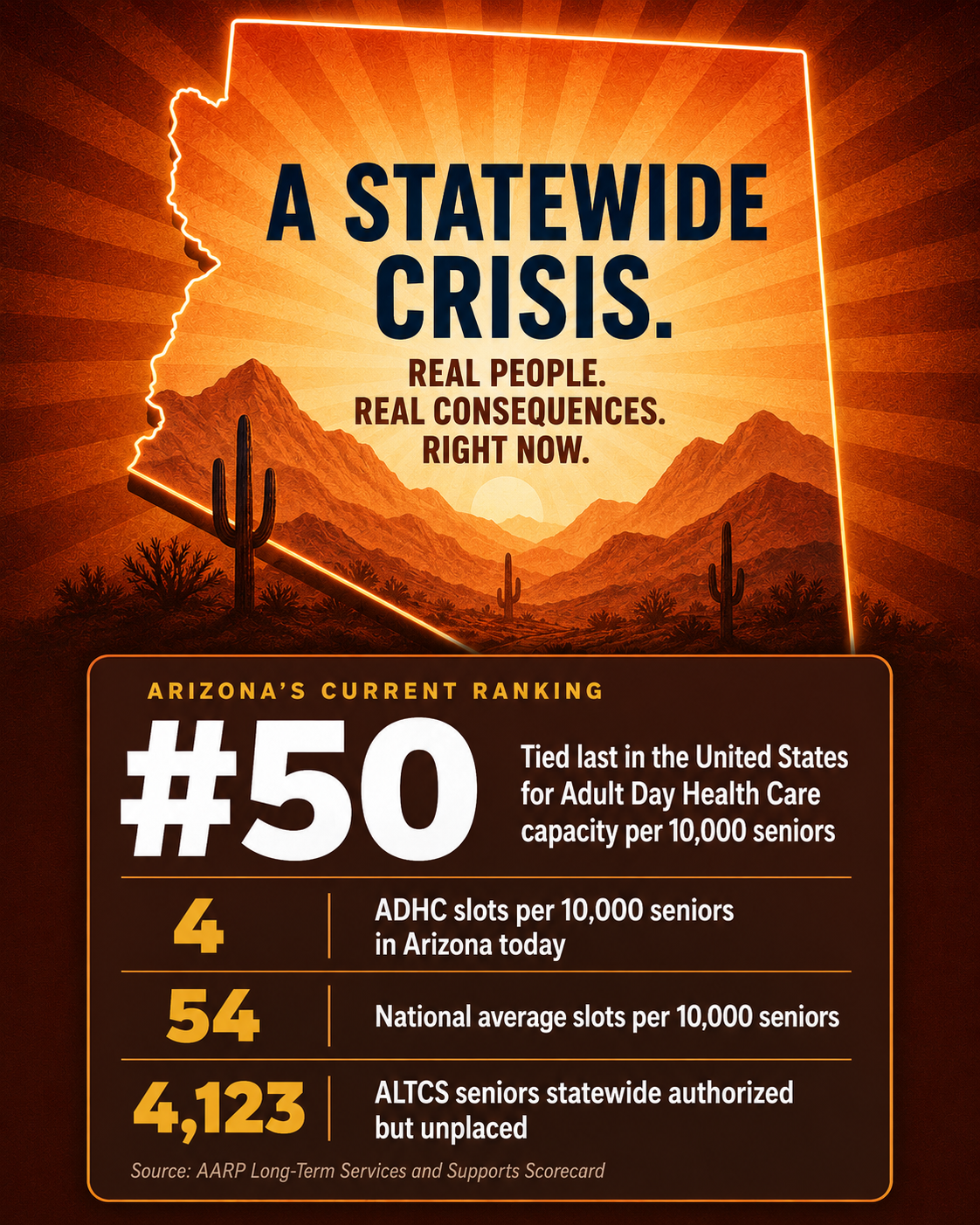
Arizona Ranks Dead Last
in the Nation for
Adult Day Health Care

Over 4,100 ALTCS-eligible seniors across Arizona are legally authorized for Adult Day Health Care services they cannot access. Not because the funding is missing. Not because they don't qualify. Because licensed providers simply don't exist in sufficient numbers — and nowhere is that gap more severe than the West Valley.

Arizona Adult Day Health Care crisis ranking and capacity data
Arizona vs. the Nation

The Gap Is Not Close. It Is Historic.

No other state comes close to Arizona's shortage. While the rest of the country has built infrastructure for aging populations, Arizona has been left dangerously behind.

Arizona — Ranked #50
4
slots per 10,000 seniors age 65 and older — the lowest in the United States, tied for last. Arizona's ADHC provider network is functionally nonexistent relative to the demand it is legally required to serve.
National Average
54
slots per 10,000 seniors — the benchmark every other state uses to plan their provider capacity. Arizona provides less than 8 cents on the dollar compared to the national average.
Top-Performing States
154
slots per 10,000 seniors in the highest-performing states — nearly 40 times what Arizona provides. These states built provider infrastructure before crisis hit. Arizona did not.
Arizona: 4 slots/10k
National avg: 54 slots/10k
Top states: 154 slots/10k
ADHC Capacity: Arizona vs. Benchmarks
Slots available per 10,000 seniors aged 65+ · Source: AARP LTSS Scorecard

Arizona's Medicaid program — ALTCS-EPD — is a managed care entitlement. Every eligible senior is legally entitled to services immediately, with no enrollment cap and no waitlist for program entry. The funding exists. The authorizations exist. What doesn't exist is the licensed provider network to deliver the care. That is a capacity failure — and it is entirely solvable.

Understanding the Gap

Authorized. Funded. Unserved.

The ALTCS process works. Every step functions as designed — until a senior reaches the point of actually receiving services. The provider shortage is the only thing standing between an authorized senior and their care.

Why "No Waitlist" Doesn't Mean "No Problem"

Arizona's ALTCS program has no formal waiting list. In theory, every eligible senior gets services immediately upon authorization. In practice, there is no licensed Adult Day Health Care provider in their community to serve them.

MCO support coordinators and care teams often face limited placement options when licensed Adult Day Health Care capacity is unavailable near a member's home. The barrier is not the member's eligibility or the service authorization. The barrier is that licensed provider capacity does not exist nearby.

This is a capacity crisis masquerading as an access crisis. The difference matters: it means the solution is a licensed facility — not more funding, not more legislation, not more authorization staff. A licensed facility in the right corridor. That is what Lending Hands Outreach provides.

1
Senior Applies for ALTCS
AHCCCS evaluates functional and financial eligibility. If the senior qualifies, ALTCS enrollment is approved and they are assigned to an MCO.
✓ System Works
2
MCO Authorizes ADHC Services
The senior's care coordinator assesses their needs and issues an authorization for Adult Day Health Care attendance. Days and hours are approved. Funding is committed.
✓ System Works
3
Care Coordinator Searches for a Provider
The MCO coordinator contacts licensed ADHC providers near the senior's home to secure a placement. This is where the system stalls — because providers are full, distant, or simply do not exist in the West Valley.
⚠ System Stalls
4
Senior Remains Unserved
The authorization sits open. The senior stays home, unsupported. Caregiver family members cannot return to work. The isolation, functional decline, and health risk continue — and the funding that was supposed to help goes unspent.
✗ System Fails
Four-County Demand Analysis

Where the Need Is — and Where We Are Going

Lending Hands Outreach launches in Maricopa County and expands to three additional Arizona counties, each with significant documented unmet demand for Adult Day Health Care services.

Launch Site
Maricopa County
Phoenix Metro · West Valley Corridor
2,848
ALTCS seniors unplaced for ADHC
Unmet Demand91%
4
MCOs to contract
25
LHO daily capacity
Pima County
Tucson Area · Future Expansion
820
ALTCS seniors unplaced for ADHC
Unmet Demand88%
Pima COA
Area agency partner
Yavapai County
Prescott Area · Future Expansion
285
ALTCS seniors unplaced for ADHC
Unmet Demand84%
Yavapai AAA
Area agency partner
Mohave County
Kingman / Lake Havasu · Future Expansion
170
ALTCS seniors unplaced for ADHC
Unmet Demand78%
WACOG
Area agency partner
Unplaced ALTCS Seniors by County
Total authorized seniors without an ADHC provider placement · All four target counties
Placed vs. Unplaced Seniors — Maricopa County
Of all ALTCS seniors authorized for ADHC services in the county · 91% unmet demand
West Valley in Focus

Why the West Valley Cannot Wait

Of the 2,848 unplaced ALTCS seniors in Maricopa County, the highest concentration lives in Maryvale, Avondale, Tolleson, and Laveen — the exact corridor where Lending Hands Outreach is building.

61.8%
of residents speak a language other than English at home — requiring linguistically responsive care
91%
of ALTCS-authorized seniors in this area have no access to a licensed ADHC facility
$0
cost to the senior or family — all services funded through AHCCCS and ALTCS managed care
#1
caregiver employment dependency of any senior-serving ZIP cluster in Phoenix Metro

In the West Valley, senior ADHC attendance is not optional for working families. This corridor has the highest caregiver employment dependency of any senior-serving ZIP code cluster in Phoenix. When a family member enters Adult Day Health Care here, it is not a convenience — the caregiver's ability to hold a job depends on it. Without a facility, seniors stay home. Caregivers stay home with them. Employment is lost. Financial stability collapses.

Why No Provider Has Filled This Gap

📍
Geographic Mismatch
The few licensed ADHC facilities that exist in Maricopa County are concentrated in Scottsdale, Chandler, and the East Valley — a 45-to-90-minute round trip from West Valley seniors who lack reliable transportation.
🔒
Existing Facilities Are at Capacity
MCO care teams may face persistent difficulty placing authorized members when nearby licensed capacity is limited or unavailable. The total provider network is not sufficient for the authorized population, especially in the West Valley corridor.
🚫
For-Profit Operators Avoid the Corridor
For-profit ADHC operators are incentivized to locate in higher-income areas or near hospital campuses. The West Valley's working-class, multilingual community is underserved by market-driven provider placement.
LHO's Nonprofit Advantage
Lending Hands Outreach is mission-driven, not margin-driven. Our faith foundation and nonprofit structure allow us to go where the need is greatest — and build lasting trust in communities that commercial operators overlook.
The Funding Opportunity

The Silver Tsunami Is Real — and Arizona Is Behind

The gap in senior care has not gone unnoticed by the philanthropic and investment community. Funding for organizations like LHO has grown dramatically over the last decade.

225%
increase in grantmakers specifically targeting older adults over the last decade — one of the fastest-growing categories in American philanthropy.
330%+
increase in grant dollars targeting senior services in the South and West regions — where Arizona sits squarely.
📈

Alzheimer's and dementia programming is among the top-three priorities for major health foundations nationally. ADHC centers — which provide structured cognitive engagement and caregiver relief — are a direct match for this investment.

🏥

Social isolation prevention has become a federal health priority under the U.S. Surgeon General's advisory framework. ADHC centers address social isolation more cost-effectively than any other intervention.

💼

Healthcare workforce development in underserved communities is a top-three focus for MCO community investment programs — Arizona Complete Health, Mercy Care, and UnitedHealthcare all operate active grant programs for exactly this purpose.

🏦

CDBG capital funding through the City of Phoenix is specifically available for Public Facility renovation in West Phoenix priority corridors — making LHO's facility acquisition strategy eligible for federal capital investment.

What This Crisis Requires

A Fundable Provider-Capacity Solution — Not Another Awareness Campaign

Arizona does not need more authorization paperwork. It needs licensed Adult Day Health Care capacity in the communities where seniors are already approved for care but cannot access services. Lending Hands Outreach is seeking launch funding, donated equipment, facility support, transportation resources, food-service partnerships, volunteer support, and MCO referral alignment to open a compliant ADHC center in the West Phoenix corridor.

Launch Capital

Operating reserve, licensing readiness, facility deposits, startup payroll, insurance, and pre-opening compliance costs.

Facility & Equipment

ADA-ready space, furnishings, commercial kitchen support, nurse station setup, safety systems, shelving, tables, and activity supplies.

Transportation Support

Wheelchair-accessible transportation resources, vehicle support, routing partnerships, and NEMT coordination capacity.

Referral Alignment

MCO, AAA, hospital, church, and community-agency partners who can help connect authorized members to available placement.

Launch Readiness

A Practical Plan Built for Compliance, Reimbursement, and Measurable Impact

Lending Hands Outreach has established a compliant service model, identified the West Phoenix target corridor, developed an AHCCCS/ALTCS reimbursement strategy, and is preparing for ADHS Provider Type 27 licensure.

The next barrier is not demand. The next barrier is launch capacity: the operating reserve, facility support, equipment, staffing, and partnership commitments needed to open safely and sustain services during the first months of operation.

Defined Service ModelAdult Day Health Care, meals, health monitoring, programming, caregiver relief, and transportation coordination.
Identified Target CorridorWest Phoenix / West Valley communities with high unmet ADHC demand and caregiver workforce dependency.
Reimbursement PathwayFee-for-service revenue through AHCCCS/ALTCS managed care organizations once contracted and licensed.
Nonprofit Leverage501(c)(3) status enables grants, donated supplies, facility support, volunteer support, and church/community partnerships.

Sources & Methodology

Capacity-ranking language is based on Adult Day Health Care capacity comparisons from the AARP Long-Term Services and Supports Scorecard. County demand figures and unmet-demand percentages are planning estimates used by Lending Hands Outreach to identify priority service corridors, evaluate provider-capacity gaps, and support launch planning.

County-level estimates may be refined as MCO contracting, referral activity, provider directory review, and member-placement data become available. The core conclusion remains unchanged: Arizona has a documented Adult Day Health Care capacity shortage, and West Phoenix requires licensed provider infrastructure to convert authorized services into actual care.

The LHO Response

This Is Why Lending Hands Outreach Exists

One Licensed Facility. One Corridor. 25 Seniors at a Time.

Lending Hands Outreach was built specifically to address the West Valley provider shortage. We are not competing with existing providers. We are entering a corridor where the provider network is thin, authorized members need placement options, and MCO partners need reliable licensed capacity close to the communities they serve.

We enter this market with advantages that are rare, documented, and hard to replicate: 25 confirmed member commitments before opening, a food partnership with St. Mary's Food Bank, 501(c)(3) status, and faith-community infrastructure through the Arizona Ministry Network.

The crisis documented on this page is not a background fact. It is the reason this organization exists — and it is precisely the gap we are built to fill.

25
Member commitments secured before opening day — eliminating the ramp-up risk that closes most ADHC startups
4
MCO contracts pursued — UnitedHealthcare, Arizona Complete Health, Mercy Care, Care1st
$0
Cost to members or families — 100% funded through AHCCCS and ALTCS managed care
501(c)(3)
Nonprofit status — enabling philanthropic and government capital funding unavailable to for-profit operators
AZ Min.
Arizona Ministry Network approved agency — built-in referral and volunteer infrastructure
ADHS
Provider Type 27 licensure in process — full regulatory compliance pathway established